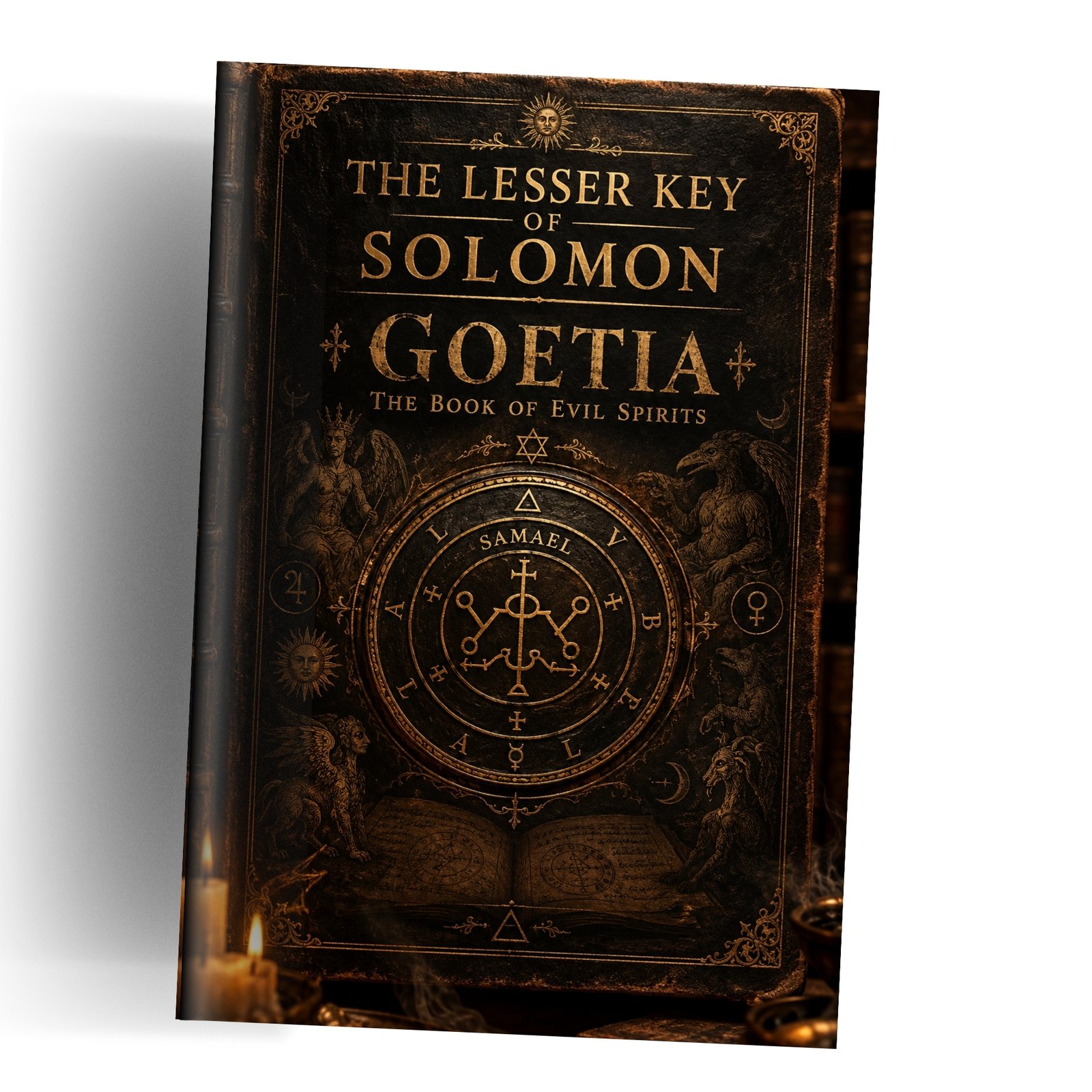
The Lesser Key of Solomon, commonly known as the Goetia, is the most notorious book in Western occultism — a 17th-century grimoire cataloging 72 demons and the rituals believed necessary to summon and command them. Often called “The Book of Evil Spirits,” it forms the first of five sections that make up the larger Lesser Key of Solomon (Lemegeton).
Origins and History
Compiled anonymously in the mid-1600s, the Goetia draws on centuries of older demonological and magical texts, including elements traced back to earlier works like the Pseudomonarchia Daemonum. Like its counterpart, the Key of Solomon, it borrows King Solomon’s name and legend to lend the text authority — claiming these methods were the very ones Solomon used to bind spirits to his will.
Structure and Content
The book systematically lists 72 spirits, each entry detailing:
- The demon’s rank (king, duke, prince, marquis, etc.)
- Their unique sigil (seal) used to summon and control them
- Their described powers — from revealing hidden treasure to teaching sciences and languages
- The number of legions of spirits under their command
Beyond the catalog of demons, the Goetia provides instructions for constructing the magic circle, the triangle of manifestation used to safely contain summoned entities, and the specific tools, timing, and conjurations required for the ritual.
Influence and Legacy
The Goetia became foundational to modern ceremonial magic, heavily influencing 19th and 20th-century occultists including Aleister Crowley, who published an annotated edition in 1904. Its demon hierarchy and sigils remain widely referenced across occult literature, tarot symbolism, horror fiction, and modern paranormal media.